







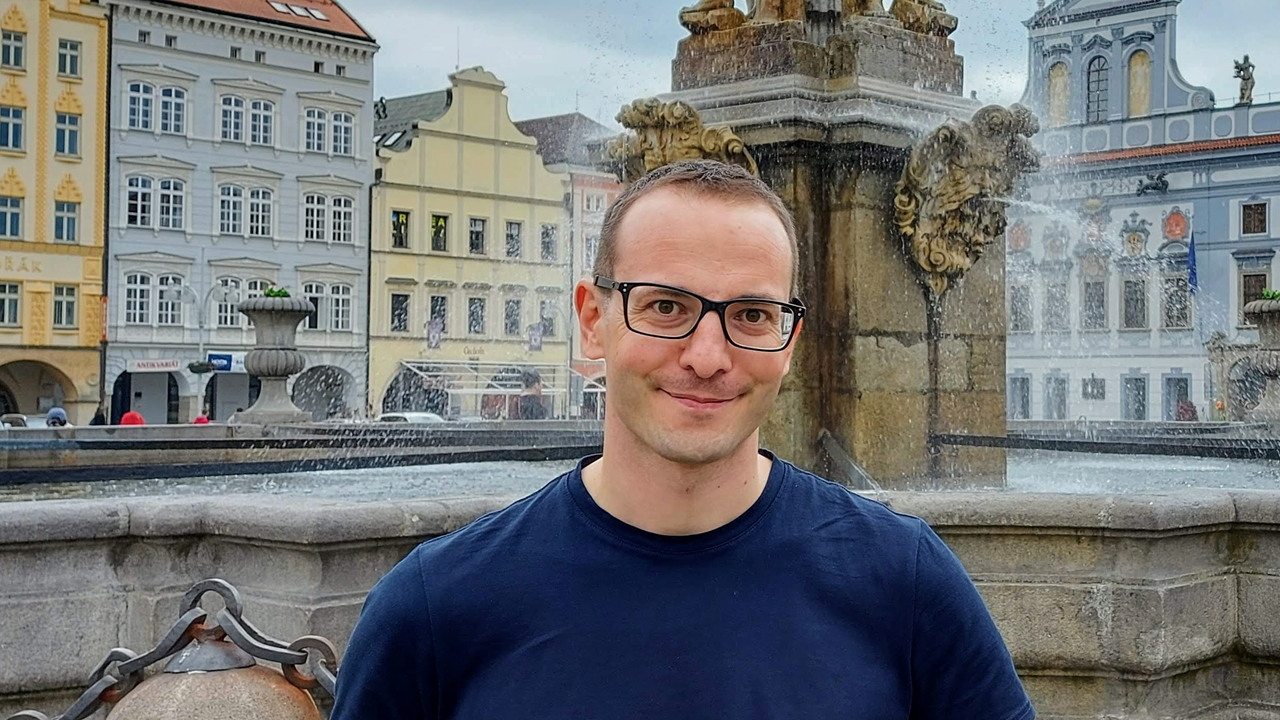
Jan Heyda has been awarded a grant in the Czech–US bilateral research programme
The Ministry of Education, Youth and Sports of the Czech Republic has announced the results of the public call LUAUS26 (bilateral research projects Czech Republic–United States) within the INTER-EXCELLENCE II programme, subprogramme INTER-ACTION, for projects running from 2026 to 2029.
Out of approximately 200 submitted proposals, 29 projects were successful, corresponding to a success rate of 14.5%. From ten proposals submitted by UCT Prague, three projects were funded. We congratulate Assoc. Prof. RNDr. Mgr. Jan Heyda, Ph.D., from the Department of Physical Chemistry, on being among the successful applicants.
For his project entitled “Membraneless Organelles in Biological Environments”, Jan Heyda secured CZK 12 million in funding. The project is scheduled to start on 1 March 2026 and will run for four years.
The project focuses on investigating how intrinsically disordered proteins (IDPs) assemble into protein condensates. When these droplet-like structures in cells are organised and functional, they are referred to as membraneless organelles. Jan Heyda and his team will study how their formation and behaviour are influenced by salt composition and the presence of cellular membranes.
On the Czech side, the project involves collaboration between the theoretical groups of Assoc. Prof. Heyda and Assoc. Prof. Vazdar. Using molecular dynamics (MD) simulations, they will investigate proteins and protein condensates in aqueous solutions at the atomic level, as well as their interactions with phospholipid membranes. The team will systematically study the effects of point mutations, various ion types, and membrane compositions to uncover the physicochemical principles governing condensate formation, stability, and adsorption on cell surfaces.
The theoretical work will be closely integrated with thermodynamic and spectroscopic experiments conducted in the laboratory of Prof. Paul Cremer at Pennsylvania State University. Prof. Cremer is an internationally recognised expert in surface-sensitive spectroscopic techniques, which he applies to study hydration and specific interactions at biological interfaces.
The long-term goal of the project is to develop a predictive “sequence–salt–membrane–phase” map, enabling rational control over the formation and properties of protein condensates. The results will contribute to a better understanding of the molecular mechanisms underlying neurodegenerative diseases (such as ALS, Alzheimer’s disease, and Huntington’s disease) and open new avenues for smart biomaterials, including ion- or temperature-responsive hydrogels and protein–membrane interfaces for biosensors.
The project will open two new PhD positions focused on molecular dynamics simulations — one at the atomistic level and one using coarse-grained models of these biosystems. All results will be shared in line with the principles of open science. Jan Heyda also anticipates the involvement of bachelor’s and master’s students, and interested candidates are encouraged to contact him directly.