







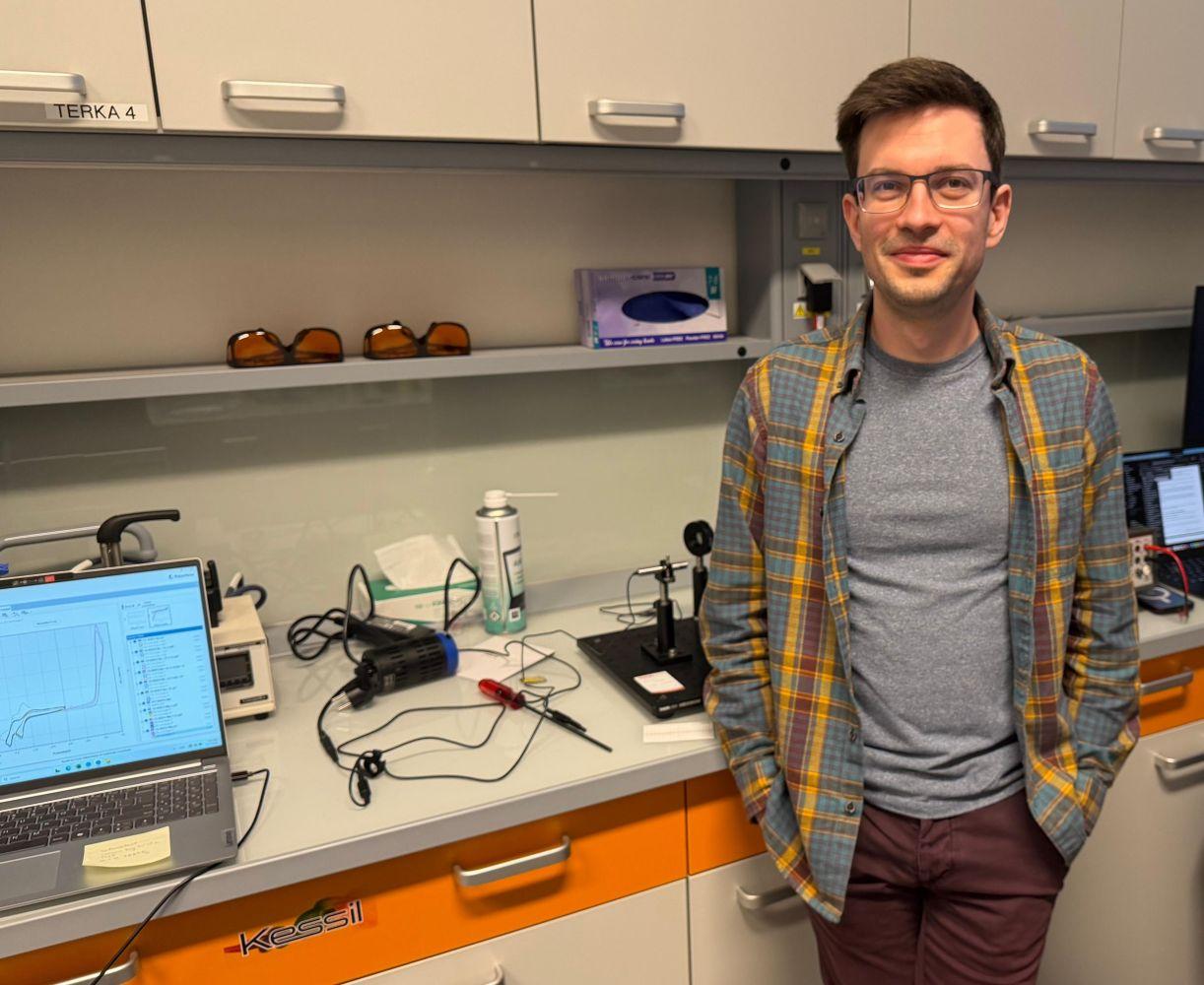
We Enjoy Watching the Dance of Molecules
Interview with the head of the "Laboratory of attosecond spectroscopy and dynamics of molecules" at the Department of Physical Chemistry, laureate of the Dream Chemistry Award and the Neuron Award – Vít Svoboda.
What does your research group focus on?
We enjoy watching molecules “dance”. And not just any molecules but specifically chiral ones because they are the best.
In December, you won the Dream Chemistry Award 2025. Tell us a bit about your journey through the competition.
The Dream Chemistry Award is a very interesting competition that allows young scientists to present big ideas. Especially ideas that, if submitted to a grant agency, they would probably respond like this: "It's a nice idea, but we won't be funding it." The Dream Chemistry Award does not fund this idea either, but it allows young researchers to write the idea down. This has the great advantage of letting you daydream and ask yourself: “If I had unlimited resources and 20 years, where would I want to be?” I let my imagination run wild, and apparently, they liked the idea.
What motivated you to accept the nomination for the competition?
I was nominated for the competition by Ivo Starý, whom I respect immensely. For a long time I didn't know what to enter the competition with, and I was afraid that I would never have a good idea again After all, that’s what I think every researcher fears. I’m not afraid to admit that I’m afraid of that. I remember that about a week before the deadline for submitting ideas, I met Pavel Jungwirth on the subway and he said to me: " Just write it down," as if it was something simple. The next day I stayed home, sat down at the computer and wrote it.
What was the hardest part of the competition for you?
Everything was the hardest part for me. But personally, I think that difficulties are meant to be overcome. For me, it’s the journey that matters, not the destination, which is why I focused primarily on the competition process. At first, I told myself, “I’ll at least try to write it down,” then I made it to the finals and thought, “I’ll at least try the finals,” and then I somehow won.
What is the future direction of the idea?
The idea behind the project is that we’d like to use the dynamics of chiral molecules for quantum computing. We would like to build something like a quantum transistor. Let's imagine that in a classical transistor, which is nothing more than a three-electrode circuit, we replace one electrode with a chiral molecule. When we then control the chirality of the molecule with light pulses, we will be able to filter which electrons (with spin up or down) can run through the electrode, i.e. our chiral molecule. This is the simplest implementation of a quantum bit. Why use chiral molecules? Today's quantum computers need powerful cooling to operate, since their quantum bits are very susceptible to losing their quantum properties at higher temperatures. But chiral molecules are stable at room temperature, which is their great advantage. Plus, I prefer 25 to -270 °C in my office.
You also received the Neuron Award. What does it mean to you?
The Neuron Award is an amazing prize, which I think is unique in the world because it supports young scientists at the beginning of their scientific careers for what they have achieved in such a short time. At the same time, it supports the popularization of science, but also senior scientists. I don't understand how it came to me, because I don't think I have accomplished anything great. Of course, I greatly appreciate the award, especially when I look at the names of the other laureates.
Do you have any recommendations for young, future scientists?
Just like with everything else in my life, I stumbled into science by accident at the age of 16. When time came to decide whether to do a PhD, my motivation to pursue the PhD was not to be a scientist who would collect awards and write successful articles. It was the collective of people I had the opportunity to work with. I ended up going to ETH Zurich for my PhD, which is a great university and therefore a highly competitive environment. At one point, I found myself in a situation where I was doing science for the sake of articles and results, but it wasn't working out. Later, I realized that I had stopped doing science for the important reason I started doing it for – because I really enjoy it and at the end of the day, I don't care if it results in an article. That's why I quickly went back to enjoy science. My advice would be only to do it if you truly love it. It's not about the goal, i.e. getting an award, producing an article, but it's about the journey. If you enjoy worrying about something completely unimportant every day, when it didn't work out even after the two hundredth attempt and you must wait for the two hundred first to make it work, then do it.
What do you like to do in your free time?
I have less free time than I would like, because I try to do well what I do here at FCE. Since I have my own group, I feel that I shouldn't do things for myself, but mainly for my students and group members. When I do have free time, I like to run because it clears my head. Even though I feel like my head is empty when I run, sometimes an interesting thought comes to my mind during or /ter a run.
Is there a question you wanted someone to ask you?
Why am I the way I am? So that I can answer that I don't know.